


The Transformative Power of the Group in Biodanza: A Neurobiological and Symbolic Synthesis
The power of the group in Biodanza emerges as the fundamental synthesis between two complementary dimensions that act synergistically: a neurobiological dimension, where specific brain mechanisms generate the conditions for connection, and a symbolic-existential dimension, where the group acts as a primordial affective matrix capable of transforming identity and facilitating human integration.
The two perspectives are not contradictory, but interdependent: the activation of the brain's social connection systems provides the biological substrate that enables the deep emotional experiences that characterise group transformation in Biodanza.
Neurobiological underpinnings: The brain designed for connection
Neuroscience has shown that the human brain has an inherently social architecture, capable of establishing resonance with other brains through specialised systems.
The Mirror Neuron System (MNS), originally discovered in the premotor cortex of monkeys and subsequently identified in humans, is one of the most fundamental mechanisms of this connection capacity.
When participants in a training session Biodanza are in a group, their mirror neurons are automatically activated in response to the movements, gestures and emotions they observe in others, allowing «observing a sensation or action to trigger the same neural activity, while remaining still and silent.
This resonance mechanism is especially powerful in the context of Biodanza, where synchronised dance and physical contact activate multiple mirror neuron systems simultaneously.
Research in neurocognition has shown that the ENS is involved in processes of imitation, understanding intentions, empathy and learning.
In Biodanza group dynamics, this means that each participant not only imitates the movements of the others, but also gains a deep and immediate understanding of their emotional states and intentions, generating a space of authentic bodily empathy.
The activation of the mirror system in the group context has significant ramifications for shared emotional regulation.
Vittorio Gallese, a leading neuroscientist in the study of mirror neurons, proposes that empathy arises from mechanisms of imitation that bring out in the observer emotions similar to those of the observed subject.
In Biodanza, where movement, music and physical closeness come together, this process is intensified: emotions are not simply observed intellectually, but experienced on a bodily and emotional level, facilitating what could be called a «collective affective resonance».
Hormonal cascade and nervous system regulation
Beyond the mirror neuron system, group interaction in Biodanza triggers a complex hormonal cascade that profoundly modulates the biological and emotional state of the participants.
The practice of Biodanza, combining music, movement and physical contact, stimulates the release of oxytocin, often referred to as «the hormone of love and trust».
Oxytocin, released during moments of emotional intimacy and physical contact, generates significant physiological effects: it promotes anxiety reduction, facilitates emotional openness, and strengthens feelings of security and belonging.
Simultaneously, the practice induces the release of dopamine, a neurotransmitter associated with reward, pleasure and social motivation.
The combination of organic music, harmonious movement and social recognition within the group creates an environment where dopamine is released in response to positive interactions, reinforcing the urge to connect and facilitating the formation of authentic social bonds.
In addition to oxytocin and dopamine, the practice of Biodanza raises levels of serotonin and endorphins, endogenous molecules that generate states of well-being, deep relaxation and natural analgesia.
This biochemical combination not only contributes to the experience of immediate pleasure, but also facilitates the regulation of the autonomic nervous system, particularly the activation of the parasympathetic system, associated with «rest and digestion».
Central to understanding the group's transformative power is the modulation of the vagus nerve, which actively monitors bodily states and regulates heart rate variability (HRV).
Group dynamics in Biodanza, especially those that combine synchronised breathing, harmonious movement and emotional contact, activate the ventral branch of the vagus nerve, related to the «calm, safety and social connection» system.
This activation generates cardiac coherence, a state of synchronisation between breathing, heart rate and emotional state, which characterises the moments of greatest integration and transformation in the sessions.
The group as affective matrix and symbolic context of transformation
Beyond the neurobiological mechanisms, the group in Biodanza also operates as an affective matrix, a fundamental symbolic space where personal identity manifests itself and evolves in the presence of the other.
In this dimension, the group is not simply an aggregate of individuals, but an environment of existential containment analogous to a mother's womb, providing emotional security, permission for change and authentic recognition.
This function of the group as a matrix is particularly relevant to understand the affective re-education proposed by Biodanza.
Transformation through Biodanza is not a mere intellectual reformulation of values, but a true transculturation, a relearning at the affective level that involves modifications in the limbic-hypothalamic regulatory centres.
The group, by providing a safe space for authentic interaction, allows each individual to experience unconditional acceptance of his or her identity, facilitating the dissolution of neurotic defences and the emergence of latent affective potentials.
In the context of the biodyanistic group, a specific form of reciprocal integration develops based on principles of reciprocity, living and self-healing.
Unlike traditional group dynamics, where there is often a hierarchical structure, the Biodanza group promotes «feedback relationships», where each participant has the freedom to accept or reject contacts, thus generating a space of fundamental respect and affective autonomy.
This horizontal structure facilitates the experience of belonging without fusion, allowing individual identity to be strengthened precisely through authentic connection with others.
The group in Biodanza also acts as a facilitator of processes of emotional reparenting, especially relevant in the context of the power of trance.
In these states, the group provides a matrix of containment that allows access to experiences of emotional rebirth, where participants can integrate ancestral emotional wounds and experience new forms of bonding based on tenderness, solidarity and mutual care.
Synergy between the neurobiological and the existential
The most potent synthesis of the power of the group in Biodanza emerges in the synergy between the neurobiological mechanisms of social connection and the existential experiences of integration and transformation.
The activation of mirror neurons, the oxytocin-dopamine-endorphin hormonal cascade and the modulation of the vagus nerve provide the concrete biological substrate that enables the intense experience of connection, empathy and security.
Simultaneously, the group as an affective matrix provides the symbolic and relational context where these experiences acquire deep and transformative meaning.
In the Biodanza session, when participants dance together, experience organic music, touch each other with emotional presence and look at each other with authenticity, a multidimensional process occurs: their mirror neurons synchronise, their hormonal systems generate an atmosphere of trust and shared pleasure, their heart rhythms achieve coherence, and simultaneously, they experience the recognition of their identity in the presence of the other, the sense of belonging to a living community, and the feeling of being held in a «collective womb» that facilitates existential transformation.
Conclusion: Transformative power in its totality
The power of the group in Biodanza cannot be reduced to biological mechanisms nor to purely symbolic dimensions, but emerges as an integrated unit where the biology of the social brain and relational existence co-create each other.
This understanding allows us to value Biodanza not only as a technique that activates specific physiological systems, but as a system of integral human transformation where neuroscientific knowledge and existential wisdom converge in the creation of environments of healing, integration and vital flowering.
In short, the group is the heart of Biodanza: it is simultaneously the «colony of mirror neurons» where bodily empathy is generated, the cocktail of hormones that facilitates emotional openness, the space of cardiac coherence where regulation becomes possible, and the existential matrix where each human being experiences the profound recognition of his vitality and his capacity to love.
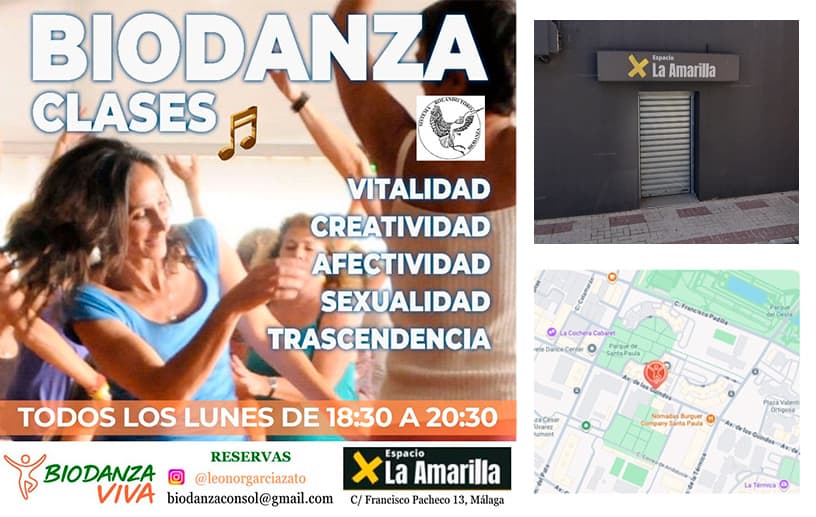
Live the experience of Biodanza in Malaga: connect with your joy, release your authenticity and transform your energy in a unique space. Book your place and start today.
y en C. Venus 22, Arroyo de la Miel, Benalmádena
